Where Should You Patent? US, Europe, China, Japan, UK, and Korea Compared
The most expensive international patent strategy is also the easiest to explain: file everywhere that sounds important.
It feels ambitious. It is usually a failure to choose.
A patent has value only where it can change somebody’s behavior. If your customers are not there, your competitors cannot be stopped there, your supply chain does not pass through there, and enforcement would never justify the cost, the country is probably a renewal-fee subscription rather than an asset.
So the honest answer to “Where should I patent?” is:
File where exclusivity would materially protect revenue, block a credible competitor, or control an important manufacturing or import route.
For many startups that produces a portfolio of two to four serious markets, not a flag collection.
There is no world patent
Patent rights are territorial. A US patent gives its owner rights under US law, including the right to exclude covered products from being imported into the United States, but it does not create patent rights in another country. The USPTO describes that territorial scope directly. A European patent that takes effect in selected European states has no effect in Japan. A Chinese patent does not give its owner rights in Korea.
The Patent Cooperation Treaty does not change that. One PCT application has the legal effect of filing separate applications across 158 contracting states during the international phase. It buys time, provides an international search, and preserves filing options. It does not itself become a granted worldwide patent.
Eventually the applicant must choose national or regional phases, pay the fees, provide translations where required, appoint local representatives, and meet each office’s rules.
International portfolios often concentrate on a small group of systems. WIPO reports that the five largest patent offices received 85.5% of worldwide patent filings in 2024: China, the United States, Japan, South Korea, and the European Patent Office. This guide also considers the UK separately because applicants can pursue it through either a direct UK application or the EPO route.
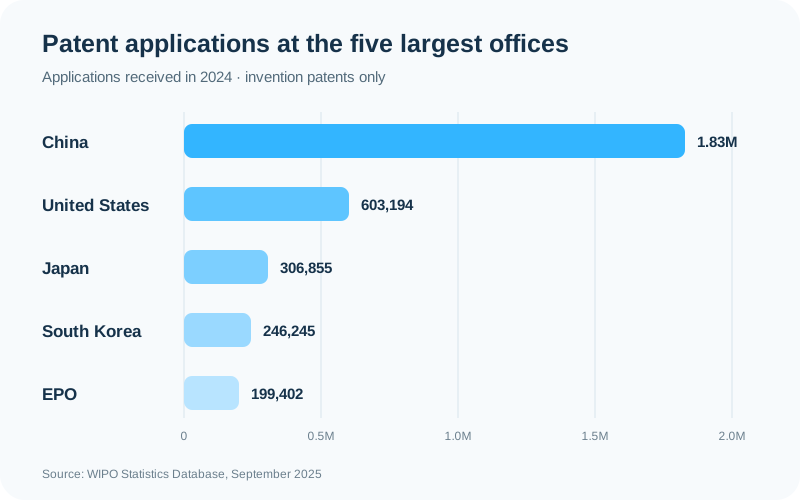
That is why this guide compares those five systems and the UK. It is not a recommendation to file in all six.
Start with five business questions
Before comparing patent offices, map the business. I would ask these questions in order.
1. Where will the profit be?
Do not count countries. Count the revenue or strategic value that a competitor could take.
A market representing 45% of expected margin deserves more attention than five countries representing 2% together. For a medical device, the valuable territory may follow reimbursement and regulatory approvals. For enterprise software, it may follow headquarters and procurement. For industrial equipment, a small country containing two dominant buyers can matter more than a large consumer market.
2. Where can a competitor be interrupted?
The best enforcement point may not be where the customer lives.
If a rival manufactures the entire product in one country and exports worldwide, a useful right there may affect the whole supply chain. Importation rights can make a major destination market valuable even when manufacturing happens elsewhere. A country where neither the rival nor the product has a meaningful presence offers little leverage.
3. Does the jurisdiction fit the technology?
Patentability and claim practice differ.
Software, diagnostics, biotechnology, business methods, and certain AI inventions can receive materially different treatment between offices. China and Japan offer utility-model systems for qualifying product structures, while the US and EPO do not offer an equivalent general route. Europe is particularly strict about added subject matter after filing. US continuation practice offers more flexibility to pursue additional claim sets from a supported disclosure.
The filing map should follow the invention, not just the market map.
4. Would you actually enforce there?
A patent is a right to exclude, not an automatic police service.
Ask whether courts can provide a useful injunction or damages, how long a dispute may take, whether evidence can be obtained, and whether the likely defendant has assets or operations that make a judgment meaningful. Local procedure and cost can matter as much as the words in the claim.
5. Can you afford the lifetime, not just filing?
Official filing fees are the friendly part of the budget. Drafting, translation, local counsel, examination responses, validation, grant, and renewals usually matter more.
The mistake is not choosing an expensive country. It is entering six countries at month 30 and abandoning four two years later because nobody budgeted for prosecution. Our patent cost guide explains why every additional country is a multiplier.
The six systems at a glance
| System | Strongest strategic reason | Common trap | Distinctive route or feature |
|---|---|---|---|
| United States | Major revenue, imports, investors, or licensees | Treating the US grace period as an international strategy | Provisional applications and continuation practice |
| EPO | Several commercially important European states | Confusing the EPO, EU, and Unitary Patent | Central examination, then national validation or unitary effect |
| China | Manufacturing, imports, local sales, or Chinese competitors | Filing only an invention patent when a product structure may support another route | Utility models for qualifying product shape or structure |
| Japan | High-value technical market or industry concentration | Weak translation of a disclosure drafted for another office | Unexamined utility-model registration for qualifying articles |
| South Korea | Semiconductors, electronics, batteries, automotive, or materials | Treating Korea as generic “Asia coverage” | Examined patents and utility models, with deferred examination available |
| United Kingdom | UK-centered customers, competitors, research, or enforcement | Filing only because the official fees are comparatively low | Direct UK filing or protection through the EPO route |
United States: revenue, flexible prosecution, expensive disputes
The US is often the first commercial choice for software, medical technology, consumer products, and venture-backed companies because of its market size, licensing activity, and investor familiarity.
It also offers filing tools that shape international strategy. A US provisional application can establish an early date for supported subject matter. Continuation practice can let an applicant pursue additional claims while a related application remains pending. Small and micro entities receive substantial fee reductions under the current USPTO fee schedule.
The tradeoffs are real. Patent litigation is expensive. Subject-matter eligibility remains difficult for some software, diagnostic, and business-method claims. The US grace period can also create false confidence: a founder may preserve limited US rights after a disclosure while losing stricter countries on the same day.
Choose the US when: the revenue, investors, licensees, competitors, or import activity make a US exclusion right commercially important.
Do not choose it merely because: the company is incorporated in Delaware or every startup seems to file there.
Europe: one examination, several post-grant choices
The European Patent Office gives applicants one central examination process. It currently has 40 member states, including the UK and countries outside the European Union.
After grant, “Europe” separates into choices:
- A classic European patent can be validated in selected member states.
- A Unitary Patent currently provides uniform protection across 18 participating EU states.
- Traditional validations can be combined with unitary effect for countries outside the Unitary Patent, including the UK.
This is why “file in the EU” is not a complete instruction. The EPO, European Union, Unitary Patent, and Unified Patent Court overlap, but they are not the same thing.
Europe rewards a complete first disclosure. Added-matter rules make it difficult to repair missing combinations during examination. It also has no general inventor grace period; EPC Article 55 contains only narrow six-month exceptions.
Choose the EPO route when: several European markets matter, central examination is more efficient than separate national applications, or European manufacturing and competitors make the territory strategically important.
Do not assume: an EPO grant automatically covers every European country or that a Unitary Patent includes the UK, Spain, Poland, or every EU member.
China: market, manufacturing, and a second type of right
China is both the world’s largest national patent filing system and a critical manufacturing territory. For hardware, electronics, machinery, medical devices, batteries, materials, and consumer products, ignoring it can leave the production side of the business exposed even when most customers are elsewhere.
China offers invention patents and utility models. CNIPA explains that invention applications pass through publication and substantive examination, while utility models pass through preliminary examination and grant. Utility models are limited to qualifying product shape or structure, last 10 years, and may be obtained faster, but their validity deserves careful analysis before enforcement. CNIPA’s official overview describes both routes.
Some applicants file an invention patent and a utility model for the same product strategy, subject to the rules against double protection. This can combine an earlier granted right with longer-term pursuit of the invention patent. It is not suitable for every technology, especially methods and purely software-based inventions.
Foreign applicants without a habitual residence or business office in mainland China generally need a licensed Chinese patent agency.
Choose China when: manufacturing, imports, local sales, licensing, or Chinese competitors are important enough that a Chinese exclusion right changes the risk.
Do not choose it merely because: the filing volume is enormous. Patent volume is not your market.
Japan and South Korea: concentrated value in technical industries
Japan and South Korea matter disproportionately in electronics, semiconductors, displays, batteries, automotive technology, robotics, materials, and precision manufacturing.
Japan permits examination to be requested within three years of filing. Korea also lets applicants defer examination within its request system. That can be a portfolio tool: file to preserve the option, then start examination when the market or competitor picture justifies the next cost. Translation quality and local claim practice are important, so these are not good places to send an English draft through a literal translation at the last minute.
Japan also maintains an unexamined utility-model registration system for qualifying article shape or construction. The JPO explains the differences, including the three-year patent examination-request deadline.
South Korea substantively examines both patents and utility models, and offers a separate deferred-examination procedure. Current procedural fees and grant charges are published by the Korean Intellectual Property Office, while its patent examination overview explains the deferred route.
Choose Japan or Korea when: the market, supply chain, research ecosystem, or named competitors create concentrated technical value.
Do not add them automatically: as generic “Asia coverage.” Japan, Korea, and China are separate rights with different commercial reasons.
United Kingdom: a focused national route and an EPO option
The UK can be reached through a direct UKIPO application or by designating the UK through an EPO application. It is an EPO member, even after Brexit, but it is not part of the Unitary Patent.
The national route has comparatively modest official fees and can provide an early search report. As of April 2026, the UKIPO lists an online filing, search, and examination package at GBP 405 for an application within the standard claim and page limits. The UK government fee guide separates official fees from professional costs.
A direct UK filing may make sense for a UK-centered business or as a deliberately chosen first filing. An EPO route may be more efficient when the UK sits inside a wider European strategy.
Choose the UK when: its customers, investors, competitors, research base, or courts matter independently.
Do not file there only: because it is inexpensive. A cheap right in an irrelevant market is still an irrelevant right.
Three illustrative filing strategies
These examples are not recommendations for a real company. They show how the business questions change the map.
A B2B software company selling to US and European enterprises
Suppose 70% of the expected revenue is split between the US and Germany, France, and the Netherlands. The engineering team is in Amsterdam, with no meaningful Asian customers or manufacturing.
A rational starting map may prioritize the US and an EPO application. Before filing, the company should test whether the invention is a patentable technical implementation in both systems rather than an abstract business rule. China, Japan, and Korea should not be added merely to make the portfolio look global.
A hardware startup manufacturing in China
Suppose the startup sells a connected industrial sensor in the US and Europe, while contract manufacturing and several direct competitors are in China.
The strategic map may include the US for customers and imports, the EPO for European buyers, and China for manufacturing and local competitors. If the novel feature lies in product structure, a Chinese utility model may be worth evaluating alongside an invention patent.
Here, China is not an optional future market. It is the place where an exclusion right may interrupt the supply chain.
A cash-constrained inventor with an uncertain market
Suppose the prototype works, but the inventor does not yet know whether the commercial partner will be American, European, or Japanese.
The right move is not necessarily three national applications immediately. A strong first filing can establish priority. By month 12, a PCT application may preserve the major options while the inventor uses the remaining international phase to test demand, raise funding, and identify partners.
The PCT costs money and creates no granted right by itself. It is valuable when the extra decision time is worth more than its cost.
How the PCT ties the plan together
The international sequence usually has two decision points:
- Month 0: file a first application with a complete enough disclosure to support the invention.
- Month 12: file directly in chosen foreign countries, submit a PCT application, or combine the two where appropriate.
- Months 30 to 31: if using the PCT, enter only the national and regional phases that still justify their cost.
The WIPO national-phase guide explains that the standard deadline is normally 30 months from the priority date, while some offices use later deadlines and a small number have special rules. Deadlines must be confirmed country by country.
Those 18 additional months are not empty waiting time. They are for gathering the evidence that decides the portfolio:
- Which markets produced real demand?
- Where are partners or licensees located?
- Which competitors appeared?
- Did the international search expose damaging prior art?
- Can the company fund translation, examination, and renewals?
The strongest country list is the one that gets shorter as the evidence improves.
Search globally, file selectively
Country selection changes where you seek rights. It does not change where prior art comes from.
A Japanese application, Chinese utility model, European thesis, or old US patent can destroy novelty even if you never plan to file in that territory. The search must therefore be worldwide even when the portfolio is selective.
This is where Patenta fits into the decision rather than appearing after it. Describe the invention once, search 160M+ patents across 100+ global patent offices, inspect where the closest technologies and competitors are concentrated, and carry that context into a first draft. The search cannot choose countries for you, but it replaces flags and assumptions with evidence.
The bottom line
Do not ask, “Which countries are important?”
Ask:
- Where will the profit be?
- Where can a competitor be stopped?
- Where does the law fit this technology?
- Where would enforcement be credible?
- Which rights can the business afford to maintain?
Then file in the smallest set of territories that produces meaningful leverage, and use the PCT only when the value of waiting justifies the cost.
Before paying for six countries, search the worldwide landscape in Patenta. Find the closest prior art, identify where the relevant assignees and technologies are concentrated, and build the filing map from evidence rather than habit.
Frequently asked questions
- Which countries should I patent my invention in?
- Usually the countries where meaningful customers buy, important competitors operate, manufacturing or import activity can be stopped, and enforcement would justify the cost. Most startups do not need every available country. They need the two to four territories where exclusivity could materially change the business.
- Is there such a thing as a worldwide patent?
- No. Patents are territorial. A PCT application preserves options and coordinates the early international process, but it never becomes a global patent. To obtain enforceable rights, the applicant must eventually enter national or regional phases and satisfy each office.
- Does a European patent cover every country in Europe?
- Not automatically. The EPO examines one European application, but after grant the owner must choose where the right takes effect. Depending on the countries and timing, that may involve traditional national validations, a Unitary Patent covering participating EU states, or a combination. The UK is an EPO member but is not part of the Unitary Patent.
- Should a hardware company file in China?
- China deserves serious consideration when the product is manufactured there, sold there, or exposed to Chinese competitors. An invention patent and, for qualifying product shape or structure, a utility model may offer different speed and examination profiles. The commercial value still depends on the actual supply chain and enforcement plan.
- How can a startup delay the cost of international patents?
- A common sequence is a first priority filing, followed within 12 months by selected direct foreign filings or a PCT application. The PCT usually postpones most national and regional phase decisions until about 30 or 31 months from the priority date. It delays country costs; it does not eliminate them.